When one thinks of clean drinking water, many things may come to mind - natural water sources, reservoirs, treatment facilities, to name a few. But you may be surprised to learn that removable insulation blankets have a role to play in bringing that fresh water to your table.
Sometimes, that role has to do with heat management. But every so often, we are called upon to helped with sound and vibrations issues that can crop up in industrial facilities. And such was to case recently at a local water treatment plant, where the 'Ozone Generators' (used to disinfect the water at the treatment plant) were letting off some 'not so good vibrations', making the surrounding area uncomfortable to work in.
After a study recommended removable insulation as a solution to the excess noise and vibration, the Firwin team was called in to propose a solution.
The final product was a blend of 2" thick mineral insulation coupled with a lb/ft² sound sheet. Since only ends of the vessel were to be covered, our design engineers also had to incorporate a unique fastening method to ensure that the blankets remained in place.
A follow up study done by the Generator manufacturer concluded that "by covering the Generator covered at both ends with a noise blanket, the noise was greatly reduced below the specification requirements of 80 dbm".
If you need some help on a sound or vibration issue, feel free to give us a call.
Tuesday, June 21, 2016
Friday, January 15, 2016
Gimme Some Space - How Much Clearance is Necessary for an Insulation Blanket?
Insulation Blankets - Thicknesses and Clearances
It is important that there is enough room around any component being insulated to allow enough space not only for the insulation blanket, but also for sufficient air space between the insulation blanket and any nearby surfaces. A lack of air space between the outer surface of an insulation blanket and another object can cause a heat build up on the blanket's outer surface and possible deterioration of the blanket material.
With the typical blanket thickness of one inch, the question arises as to what to do with applications that require removable insulation, but have low clearances around all or part of the components to be covered?
"Insulating areas with low clearances can be an issue, but it often depends on the particulars of an application and what the client is
wishing to achieve", said Brett Herman, Firwin's VP of Sales & Engineering. "For instance, sometimes just thinning out the insulation in areas of low clearance will still give the client sufficient insulation performance for the needs of his particular application. If, on the other hand, we are dealing with a relatively high temperature application, and the client has a particular temperature reduction goal that he wishes to achieve - this could be for personnel protection, or to ensure that nearby heat sensitive components are shielded from overheating - Whatever the reason, a lack of clearance means we are limited in the thickness of insulation that we can apply, which in turn can limit the amount of heat reduction that results".
Solutions for Low Clearance Issues
So what solutions are available for situations where clearances restrictions would seem to limit the use of insulation blankets? "In situations where the client needs to achieve a certain temperature reduction, and there is insufficient room for the thickness that would be needed with standard fiberglass insulation, we have other solutions that we can offer to help the client achieve his goals", said Brett.
"The first possibility we would look at is upgrading to a higher temperature insulation, such as MW1800 or FW2000+. These insulations have a higher temperature rating than our standard fiberglass FW1200, and sometimes when all that is needed is a small increase in insulation performance at a given thickness, these insulations will do the trick, with the price premium being relatively small ", notes Brett.
"If however, these do not suffice, the next step is to look at a high performance insulation such as Aerogel. It does carry a price premium, but it is one of the most effective insulators on the market, and will allow a client to achieve larger temperature reductions with a thin layer of insulation".
High Performance Insulators
Insulation blankets are made up of 3 parts: The outer cover, also known as the `cold face`, the middle layer of insulation material, and the inner cover, or `hot face`. For most applications, the `standard` insulation blanket makeup of a silicone outer cover, 1 inch thick fiberglass, and a mesh inner liner, works fine. But certain applications demand alternative materials, be it because of very high temperatures, the environment where the insulation blankets will be operating, or in the case here, because of a combination of space constraints and desired insulation performance. "Space constraints alone do not necessarily demand the use of an alternative insulator such as Aerogel", said Brett. "It is possible that the customer`s needs can be met with a thin layer of fiberglass or superwool. An insulator like Aerogel is brought into the picture when the project needs insulation performance that typically could only be achieved with thicker insulation than the space allows."
The chart below gives an indication of what kind of insulation effectiveness can be achieved even with a very thin layer of Aerogel insulation, compared to other insulations at standard 1" thickness. As can be seen, even a thin 10 mm (approximately .4 inches) layer of Aerogel gives an insulation effectiveness near that of a 1" thick fiberglass blanket.
Wednesday, December 23, 2015
Can removable insulation blankets keep pipe contents from freezing ?
Removable insulation blankets are great at managing heat. Be it by lowering the ambient heat in an engine room, protecting workers from hot surfaces, or shielding pipe contents from cold external temperatures, removable insulation covers are often the solution of choice where heat must be managed, but permanent insulation is not feasible. | Gate Valve with Glycol Tracing,, wrapped with Removable Insulation Blanket |
But there is one thing that removable insulation blankets cannot do - they cannot add heat. "We often get asked, particularly in cold weather applications, if our blankets can keep pipe contents or components from freezing", said Brett Herman, Firwin`s VP of Sales & Engineering. "The answer is that while we can contain heat and delay heat loss by sheltering pipe components from cold external temperatures, our insulation blankets can`t add any heat that isn`t already there."
Where insulation blankets can help, however, is where companies have some sort of heat tracing on their piping, and they want to minimize the amount of heat lost to the environment, and thus maximize the efficiency of their heat tracing.
Heat Tracing Challenges
"Companies, particularly in the oil and gas industry, and often in other industries such as mining, chemical, and food processing, use heat tracing to keep pipe or container contents from freezing. In cold temperatures, this heat tracing, if left un-insulated, becomes much less effective. Firwin has done a number of applications in this area, covering the component and the heat tracing, increasing efficiency and lowering the heat that escapes to the environment", added Brett.
Like other removable insulation blanket applications, a properly designed blanket is key to ensuring that the heat tracing is properly insulated. "There are various type of heat tracing in the marketplace today - steam, glycol, hot oil, and electric", said Rael Herman, Firwin's VP of Production & New Product Development.
"In some instances, the entire component in covered by a 'bolt-on heat jacket, changing the entire geometry of the part". What they all have in common is the need to be wrapped tightly, so as to minimize the amount of heat that is lost to the environment. The challenge, when it comes to insulation blankets, is to design a blanket that will account for the sometime difficult geometries and penetration access points that often come hand in hand with heat tracing", said Rael.
![]() |
| Firwin Blanket custom designed to fit glycol penetrations |
Other Solutions
What about situations where the customer is not familiar with heat tracing, or where heat tracing is not a viable option ? "We have done applications where we have incorporated a heat source into the insulation cover (see previous article on "pizza blankets")", notes Brett. "Regardless of who supplies the heat tracing, what's important is ensuring that the the insulation blankets are designed in such a way as to tightly cover the components in question, while allowing for penetration points that typically accompany tracing of valves and similar components".
For more information on removable insulation blankets and heat tracing, please contact Firwin.
Wednesday, February 4, 2015
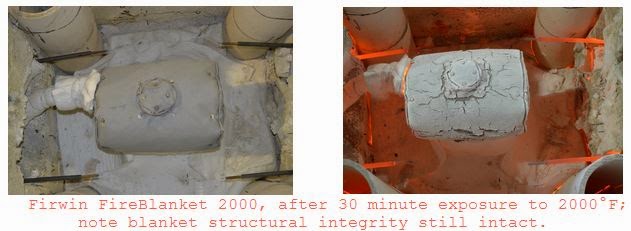
Firwin FireBlanket 2000 Can Take the Heat: It’s Proven to Withstand Temperatures as High as 2000-Degrees-Fahrenheit!
In our last blog post, we reviewed how the Firwin FireBlanket 2000 protects industrial safety valves and actuators.
We explained how a removable insulation blanket designed to protect safety valves is different from the standard insulation blankets you’ll find in industrial settings. In this blog post, we’ll talk more about the design of this type of fire blanket and explain how strong and durable it is (and why it needs to be this way!).
The Firwin FireBlanket 2000 is designed to keep the heat and fire away from the part. Typically, removable insulation blankets are composed of three layers:
1. the inner surface
2. the insulation material that rests on the inner surface
3. the outer protective cover.
In most cases, the removable insulation blanket’s inner surface is the “hot face” that comes in direct contact with the hot component. However, the Firwin FireBlanket 2000’s outer protective cover is the “hot face” and it needs to withstand extremely high temperatures. The FireBlanket is working “in reverse,” in layman’s terms: The outer surface and insulation are protecting the part from the heat, and the outer protective cover needs to withstand the very high heat of a fire.
There are also other variables that come into play in a fire safety situation at an industrial plant, and time is a critical factor. The valve or actuator being protected by the FireBlanket will need to function and operate properly to allow enough time for the operator to shut down a line. In situations like this, a FireBlanket’s outer cover may deteriorate too quickly if it’s not manufactured to meet certain fire standards. It’s also important to install the FireBlanket so that the component is properly protected – an improperly installed FireBlanket could impede the blanket’s ability to protect the component in case of fire.
The Firwin FireBlanket 2000 easily passed the UL rapid rise fire standard test (UL1709) where it was placed in a special compartment and blasted with 2000-degrees-Fahrenheit temperatures for 30 minutes. The fire blanket – including its outer protective – remained fully intact throughout the test, with no signs of deterioration at all. This proves that the Firwin FireBlanket 2000 can definitely take the heat!
We explained how a removable insulation blanket designed to protect safety valves is different from the standard insulation blankets you’ll find in industrial settings. In this blog post, we’ll talk more about the design of this type of fire blanket and explain how strong and durable it is (and why it needs to be this way!).
The Firwin FireBlanket 2000 is designed to keep the heat and fire away from the part. Typically, removable insulation blankets are composed of three layers:
1. the inner surface
2. the insulation material that rests on the inner surface
3. the outer protective cover.
In most cases, the removable insulation blanket’s inner surface is the “hot face” that comes in direct contact with the hot component. However, the Firwin FireBlanket 2000’s outer protective cover is the “hot face” and it needs to withstand extremely high temperatures. The FireBlanket is working “in reverse,” in layman’s terms: The outer surface and insulation are protecting the part from the heat, and the outer protective cover needs to withstand the very high heat of a fire.
There are also other variables that come into play in a fire safety situation at an industrial plant, and time is a critical factor. The valve or actuator being protected by the FireBlanket will need to function and operate properly to allow enough time for the operator to shut down a line. In situations like this, a FireBlanket’s outer cover may deteriorate too quickly if it’s not manufactured to meet certain fire standards. It’s also important to install the FireBlanket so that the component is properly protected – an improperly installed FireBlanket could impede the blanket’s ability to protect the component in case of fire.
The Firwin FireBlanket 2000 easily passed the UL rapid rise fire standard test (UL1709) where it was placed in a special compartment and blasted with 2000-degrees-Fahrenheit temperatures for 30 minutes. The fire blanket – including its outer protective – remained fully intact throughout the test, with no signs of deterioration at all. This proves that the Firwin FireBlanket 2000 can definitely take the heat!
Monday, January 26, 2015
A Fire Blanket Designed to Protect Industrial Safety Valves is Definitely Worth the Investment
You’ve probably heard about fire blankets that are designed to protect people in their homes or in their workplaces. These types of fire blankets are commonly used to extinguish and smother fires or as portable safety devices to wrap around people as they run for safety. But, have you heard about fire blankets that are designed to protect industrial safety valves and equipment?
Fire blankets designed to protect industrial safety valves are a type of insulation blanket, but they differ from standard insulation blankets used in industrial settings. Standard blankets are meant to insulate a part to maintain a high level of heat inside the part, or to keep heat away from the outside environment. For instance, in many industries, machine and equipment parts must be kept at the right temperature for the part to function properly; conversely, heat must be contained and kept away from the surrounding area, be it for personnel protection or protecting nearby heat sensitive components. However, fire blankets designed to go over a part – typically a safety-related part, such as a gate valve or an actuator – are designed to keep the heat and fire away from the part. These types of fire blankets are needed in many industries, including the oil and gas industry.
A fire blanket that protects a valve, an actuator or another part from fire and heat is a critical industrial safety tool. Gate valves and actuators function as safety mechanisms in industrial settings. In the event of any type of fire, including chemical fires, these actuators perform a safety shutdown to reduce fire spread and prevent or minimize disaster. The fire blanket is designed to go over a valve or part to protect its covering long enough for safety procedures to function properly. Designed to withstand a fire for up to 30 minutes, this allows enough time for an operator to actuate the safety function on a line and to perform a shutdown to keep the fire under control and to minimize potential damage.
The fire blanket we offer at Firwin works to protect industrial valves and actuators so that they can do their job in a critical safety situation, and they’re proven to work: Our fire blanket for industrial safety valves and parts was tested in a UL rapid rise fire standard test (UL1709) where it was placed in a special compartment and blasted with 2000-degrees-Fahrenheit temperatures for 30 minutes. The fire blanket remained intact throughout the test.
A fire blanket designed to protect industrial safety valves and equipment is definitely worth the investment! To learn more about the fire blanket, read the article Firwin FireBlanket 2000 in our e-newsletter.
Friday, December 19, 2014
Standard vs. “Donut” Flange Covers: The Differences and the Advantages
You may be aware that it’s important to have a covering for
flanges—and it’s especially important that this covering be high quality and
durable.
But did you know that there’s more than one kind of flange
cover? In fact, we at Firwin offer two basic flange cover options: our standard
cover, and our “donut” cover. Both are made of the highest quality materials
and are reliable and effective, but they differ in several ways.
Let’s examine both, and what makes each unique and
beneficial.
Standard Flange
Covers
Our standard flange covers are one-piece insulation blankets
that cover the flange, wrapping around it and closing through the use of draw
strings—which compress the blanket at the edges, pulling it tightly around the
flange.
This design allows for flexibility, so that the blanket will
cover the flange even if the actual dimensions differ slightly from the assumed
ones. This also means that in the case of an adjacent existing flange that
restricts the amount of exposed pipe around which the cover is being placed,
installation is still possible.
While flexibility and quality are always assured, one
disadvantage is that installation can be a bit tricky for someone who isn’t
familiar with insulation blanket installation, and can lead to an uneven
appearance.
“Donut” Flange Covers
Alternatively, our donut flange covers consist of three
parts—the main body cover and two end pieces—and this design allows for easier
installation than our standard cover, and a smoother look. For these reasons,
the donut flange covers are preferable in certain circumstances, particularly
when the aesthetics are especially important and the user prefers a more
customized appearance.
However, because of the extra material and design
engineering, donut flange covers are more expensive than standard ones. Those
who choose these covers are paying a premium for easier installation and a more
seamless, smoother look.
Either way, whichever cover you choose, you can rest assured
that the design and material quality will never be compromised. Like all of our
products, both styles of flange covers are the best of their kind, and deliver
exceptional quality every time.
Of course, if you have any questions or would like to know
more about which is best for your needs, please don’t hesitate to contact us anytime.
Thursday, August 21, 2014
Stopping Noise Pollution with Firwin
Often times when we think of noise pollution, a loud car stereo or perhaps a dog barking might come to mind. However, in the industrial world, noise or sound is not just a nuisance, it can actually be dangerous.
According to the NIDCD, noise-related deafness is a 100% preventable disorder. Using earplugs certainly helps, but the best way to avoid damage is to remove the sound from the environment. At Firwin, we understand how critical sound absorption and attenuation is in industrial settings, especially when it comes to diesel-powered equipment.
We bring up diesel-powered equipment because it can be found in a wide variety of industries. These machines can be extremely loud, especially when used in enclosed spaces. OSHA states that 85dBs is a tolerable noise level; the average diesel engine room can reach a deafening 120dBs, which is the same as a fireworks display. This level of noise pollution is dangerous for workers and the public.
The best way to combat noise pollution is to use panels, curtains, absorbers, and blankets. The experts at Firwin will often combine sound absorption technologies with our insulation. Firwin also has a selection of sound attenuation products like our AcoustiGuard™ Quilted Barrier/Absorber Curtain Panels and AcoustiGuard™ Pipe/Duct Lagging, among others. All of these sound attenuation products can help reduce levels of noise pollution in almost any situation, thus keeping you and your workforce safer.
While there are many factors to consider when choosing proper sound attenuation, including the thickness of the material, space around the equipment, and proper paneling, we understand the importance of limiting noise pollution and have the products to fit your specific application.
According to the NIDCD, noise-related deafness is a 100% preventable disorder. Using earplugs certainly helps, but the best way to avoid damage is to remove the sound from the environment. At Firwin, we understand how critical sound absorption and attenuation is in industrial settings, especially when it comes to diesel-powered equipment.
We bring up diesel-powered equipment because it can be found in a wide variety of industries. These machines can be extremely loud, especially when used in enclosed spaces. OSHA states that 85dBs is a tolerable noise level; the average diesel engine room can reach a deafening 120dBs, which is the same as a fireworks display. This level of noise pollution is dangerous for workers and the public.
The best way to combat noise pollution is to use panels, curtains, absorbers, and blankets. The experts at Firwin will often combine sound absorption technologies with our insulation. Firwin also has a selection of sound attenuation products like our AcoustiGuard™ Quilted Barrier/Absorber Curtain Panels and AcoustiGuard™ Pipe/Duct Lagging, among others. All of these sound attenuation products can help reduce levels of noise pollution in almost any situation, thus keeping you and your workforce safer.
While there are many factors to consider when choosing proper sound attenuation, including the thickness of the material, space around the equipment, and proper paneling, we understand the importance of limiting noise pollution and have the products to fit your specific application.
Monday, March 31, 2014
Increasing Engine Efficiency with Insulation Blankets
Many of today’s modern engines have two chargers that help to improve engine efficiency, and for which insulation blankets have an important role to play—turbochargers and charge-air coolers.
To understand how insulation can help you get the best performance from your engine, you first need to know how turbochargers work. The function of a turbocharger is to increase the mass of air that enters the engine, which leads to a greater air/fuel mix and boosts the horsepower. This is achieved by an internal turbine and corresponding compressor. The turbine, which can spin at speeds over 200,000 rpm, drives a compressor, which increases the amount of air entering an engine’s cylinders. Because the turbocharger’s turbine is powered by the engine’s own exhaust and because of the rapid rpms, turbochargers run at extremely hot temperatures.
The extreme heat generated by turbochargers can stress sensitive engine parts in the piston and cylinder area, and have a detrimental effect on surrounding engine components and employee safety.
Unlike turbochargers, charge air coolers run cold. Charge air coolers work to cool the compressed air that leaves the compressor before the air enters the engine. The increased density of the colder air means that more air can fit into the engine, for greater power. Charge air coolers thus improve the efficiency of the turbocharger and engine by allowing a greater mass of air to enter the engine at one time.
Insulation blankets are used in conjunction with both turbochargers and charge air coolers. For turbochargers, the blankets keep the heat from escaping the turbochargers and from entering the surrounding engine components. For charge air coolers, insulation blankets are found on the hot piping that leads from the turbocharger to the cooler, in order to protect personnel who might be in the area.
To learn more about how Firwin’s insulation blankets can improve the efficiency of your engine, please visit our website or contact us today!
Friday, February 28, 2014
Visit our new site!
In case you haven’t noticed already, Firwin has a newly designed website for customers in the petrochemical, chemical, and oil & gas industries. The new site, www.firwinthermowrap.com, sports an updated look and feel, while keeping the navigation and content similar to our main site. In redesigning this online platform of our capabilities, products, and applications, we closely considered our customer’s needs. We’ve catered to audiences that are both familiar and unfamiliar with our company by streamlining the navigation, adding useful images, and highlighting our most popular products.
The first things that’ll catch your eye are the content buckets on the home page. The content buckets compartmentalize chunks of information that are specific to a certain topic. Experienced users, for example, will be able to access information about our products quickly by scanning the links under the list of Products & Services. Others that are newer to Firwin can read about our past successes by clicking on our various case studies. The new site prominently places a lot of important information for customers both new and old right on the home page.
We’ve also added quite a number of high resolution photos to the site, in a photo gallery. These pictures not only serve to educate new customers about our Thermowrap product line, but also may inspire experienced professionals with new solutions to equipment issues. You can view our Thermowrap products at work in a variety of different applications. One notable image in our photo gallery shows our product installed around a gate valve with glycol tracing, a complex piece of equipment with many bends and components. The images in our gallery may help you visualize how your next insulation project might look upon completion.
Overall, we’re focusing this new site on our Thermowrap product line of removable insulation covers. We hope that the site serves our customers in the petrochemical, oil & gas industries well and is a useful resource for anyone looking for insulation covers. If you haven’t seen it yet, please take a look at our new site today!
The first things that’ll catch your eye are the content buckets on the home page. The content buckets compartmentalize chunks of information that are specific to a certain topic. Experienced users, for example, will be able to access information about our products quickly by scanning the links under the list of Products & Services. Others that are newer to Firwin can read about our past successes by clicking on our various case studies. The new site prominently places a lot of important information for customers both new and old right on the home page.
We’ve also added quite a number of high resolution photos to the site, in a photo gallery. These pictures not only serve to educate new customers about our Thermowrap product line, but also may inspire experienced professionals with new solutions to equipment issues. You can view our Thermowrap products at work in a variety of different applications. One notable image in our photo gallery shows our product installed around a gate valve with glycol tracing, a complex piece of equipment with many bends and components. The images in our gallery may help you visualize how your next insulation project might look upon completion.
Overall, we’re focusing this new site on our Thermowrap product line of removable insulation covers. We hope that the site serves our customers in the petrochemical, oil & gas industries well and is a useful resource for anyone looking for insulation covers. If you haven’t seen it yet, please take a look at our new site today!
Friday, January 31, 2014
Stop the Deep Freeze with Firwin
Wintertime, especially north of the border, means one thing: cold weather. Every year at this time, many of our industrial customers want to know if Firwin offers an insulation product that can keep piping and components from freezing. If you’ve ever owned a house, you know that frozen pipes can lead to disaster; now, just imagine if you are in charge of millions of dollars of industrial equipment under the same conditions.
At Firwin, we recognized that many of our customers operating in colder climates needed to find a way to both retain and create heat to keep their equipment safe and effective. After a number of tests and prototypes, our R&D department came up with the perfect solution, the ‘pizza blanket’. Modeled after the insulated satchels pizza delivery people use to keep your food warm during transit, our pizza blanket introduces heat through a series of electric coils in order to prevent equipment from freezing up in harsh conditions. Of course, our pizza blankets are more than just heating pads; they also have all the properties of standard removable insulation blankets, including the ability to retain and contain heat. The combination of heating elements and insulation blankets means that our customers who operate in the harshest cold-weather conditions can be sure their facilities will constantly run at peak performance.
So, if you’re facing a long cold winter and you need to know that your equipment won’t freeze up, contact Firwin today and let us tell you more about our innovative and cost-saving pizza blankets.
At Firwin, we recognized that many of our customers operating in colder climates needed to find a way to both retain and create heat to keep their equipment safe and effective. After a number of tests and prototypes, our R&D department came up with the perfect solution, the ‘pizza blanket’. Modeled after the insulated satchels pizza delivery people use to keep your food warm during transit, our pizza blanket introduces heat through a series of electric coils in order to prevent equipment from freezing up in harsh conditions. Of course, our pizza blankets are more than just heating pads; they also have all the properties of standard removable insulation blankets, including the ability to retain and contain heat. The combination of heating elements and insulation blankets means that our customers who operate in the harshest cold-weather conditions can be sure their facilities will constantly run at peak performance.
So, if you’re facing a long cold winter and you need to know that your equipment won’t freeze up, contact Firwin today and let us tell you more about our innovative and cost-saving pizza blankets.
Monday, December 30, 2013
What to do about a square peg in a round hole?
Odd shapes and sizes are always something that design engineers encounter when creating everything from pipe fittings to fasteners. With insulation blankets, varying geometries and protrusions from engine and exhaust components and process piping are regularly encountered in the design phase. At this point, when the surface to be covered isn’t smooth, how does that blanket fit?
Here is where our custom blanket services fit in. When it comes to the design portion of the production phase, our design engineers evaluate the surface and piping, and can create a blanket to accommodate any protrusions or cut outs.
How do we go about this with our customers? There are a few different options of reviewing and obtaining this kind of information. First and foremost, if the insulation blanket is needed in an emergency situation, with no lead time to make a custom cover, we can send a blanket and the customers can make the cut outs themselves according to the placement of the brackets. If that is not the situation, then our design engineers look at the end application. If the jacket will be covering a silencer, then they will supply the customer with a support brackets drawing they can fill out. If it’s a different component—such as for the oil and gas industry—we will then ask for CAD drawings or specific dimensions from the customer. Despite the application, it’s always pertinent for our design engineers to have drawings of the equipment that will be blanketed.
The most important aspect of the blanket design is that, according to our article, our “design team ensures that any cut-outs or openings are designed in such a way as to allow sufficient room for the protruding item, while minimizing any heat loss due to the lack of insulation.”
Whether you’re worried about complex geometries or protruding components on your equipment, don’t fear—our design engineers can create an insulation blanket for every application.
Wednesday, November 13, 2013
A Look at Firwin’s Product Information Guide
At Firwin, we always want to make sure that you get the most out of our removable insulation blankets. When you purchase any of Firwin’s removable insulation covers for the first time, we not only provide you with a high quality product, but also a world-class product information guide. The 24-page guide covers a wide variety of topics including:
- An overview of removable insulation blankets
- Detailed installation instructions including common errors to avoid
- A closer look at harder to identify parts like segmented elbows, flanges, and cones
- Alternative fastening methods
- How to care for new blankets
- How to keep the highest level of safety during usage
While we provide top quality covers, we also want to provide top quality service. Is there anything missing from the guide? If so, let us know!
Monday, September 23, 2013
Tips on Caring for your Removable Insulation Blankets
At Firwin, we take pride in the performance and longevity of our removable insulation blankets. We manufacture all of our products to withstand the toughest and most challenging environments, be it hundreds of feet underground or on the roughest seas. In order to make sure our insulation jackets maintain peak performance, it helps to follow a few easy care tips.
- Firwin’s fastening systems are extremely strong, but it is important to avoid excess force when installing your insulation blankets.
- It isn’t always easy, but for the best service, keep your blankets as clean as possible.
- Promptly remove or clean off all chemicals that cause deterioration of aluminum or silicone coatings.
- Avoid oil saturation; this will render your blanket’s “non-combustible” characteristics ineffective. You will then need to replace the covers.
- Treat blankets like all parts of the engine and inspect them regularly.
- Last but not least, always take care not to cut or damage the outer protective cover fabrics. It helps to limit the usage of sharp instruments around all insulation blankets.
Tuesday, August 27, 2013
Choosing the Right Material for Your Insulation Blankets - Part 4: Fastening Systems
For the final installment of our Choosing the Right Material for Your Insulation Blankets series, we are going to look at fastening systems. As we have seen, arriving at the right combination of materials for your insulation blankets takes a lot of time and expertise. The same holds true for the fastening system used to hold your insulation covers in place. Just like with outer covers, inner liners, and the insulation itself, fastening systems come in a variety of materials to fit your specific needs.
- Stainless Steel Lacing Wire with Rivets
- Silicone Straps with Buckles/Rings
- Kevlar Straps with Buckles/Rings
- Stainless Steel Mesh Straps with Buckles/Rings
- Springs
- Snaps
- Velcro (polyester)
- Nomex Velcro
- Stainless Steel Velcro hooks with Nomex Velcro Fasteners
There you have it—From the basics to material choices to the fastening systems, we have outlined all of the steps in choosing the right insulation blanket for your application.
Monday, July 22, 2013
Choosing the Right Material for Your Insulation Blankets - Part 3: Outer and Inner Covers
In our last installment of Choosing the Right Material for Your Insulation Blankets, we went over basic insulation materials. This time around, let’s review more in-depth and discuss outer and inner covers. We have a lot of ground to cover, so we will break down the materials into three categories of usage: Outer Covers, Inner Liners, and those than can do both.
Outer Covers
- Aluminized Fiberglass
- Heavy Duty Silicone
- Stainless Steel Laminate Fiberglass
Inner Liners
- Stainless Steel Mesh 304
- Stainless Steel Mesh 309, 316
- Stainless Steel Mesh Foil with Mesh Cover
- Stainless Steel Mesh Inconel
Outer Cover and Inner Liner
- Silicone Impregnated Fiberglass
- PTFE Coated Fiberglass
- PVC
- Fiberglass HT
- Silica
Choosing the correct insulation blanket material makeup can be daunting—you need industry experts at a company like Firwin to recommend the right combination for your application.
Thursday, June 20, 2013
Choosing the Right Material for Your Insulation Blankets - Part 2: General Insulation Materials
We have already discussed the criteria that need to be analyzed when choosing the correct insulation blanket material. With that out of the way, now it is time to look at the actual insulation materials typically found in insulation blankets.
- Fiberglass
- CMS Wool
- Mineral Wool
- Aerogel
Stay tuned for Part 3, where we cover the different materials available for your insulation’s outer and inner covers.
Wednesday, May 22, 2013
Choosing the Right Material for Your Insulation Blankets - Part 1: The basics
When it comes to insulation covers, blankets, and jackets, one size does not fit all. In order to match your specific application with the correct insulation materials, quite a few factors need to be considered. An incorrect insulation blanket can cost you money, time, and even the safety of your workers and customers. Some of the factors that must be taken into consideration when selecting the correct insulation materials for your particular application include:
- Maximum temperature range of the application in question
- Desired outer surface “touch” temperature
- Exposure to elements (i.e. water, chemicals, debris, etc.)
- Safety and regulatory requirements
- Space limitations
- Frequency of insulation removal
- Aesthetic requirements
It is imperative that your insulation blanket provider is aware of these basic factors. Your Firwin rep can walk you through these steps and ensure that you get the right blanket for your application.
Tuesday, April 30, 2013
Did You Know Our Fiberglass Insulation Blankets Are UL-Certified?
Are you involved in any projects or processes with or requiring UL-certification? If so, then it is necessary that all components of that project or process need to be UL-certified, including insulation blankets. For instance, if you’re building a generator set – a process that is specified as requiring UL certification—you’ll need UL-certified insulation blankets. Here at Firwin, our fiberglass insulation jackets meet this requirement.
Firwin’s fiberglass insulation blankets are used to insulate engine parts, exhaust piping and components, and industrial process piping and machinery. They’re used in just about every industry requiring insulation blankets to manage heat generated by various industrial processes, and if UL-certification is required, Firwin’s fiberglass insulation covers have got you covered. They’re fire-resistant, they can withstand extremely high temperatures, and they’re all UL-certified.
What does UL certification mean? According to the UL website, UL-certification is defined as “a process that determines that the source, substance, quality, manufacture, performance, described features, precision, ruggedness or other characteristics of a product or service meets the standard/s, code or criteria developed for that product or service.”
The UL website also says, “Dedicated to promoting safe living and working environments, UL helps safeguard people, products and places in important ways, facilitating trade and providing peace of mind.” At Firwin, we share this same dedication, and with our fiberglass insulation covers– all UL-certified – we help to promote fire safety practices in all industries.
Tuesday, April 9, 2013
The Latest Rap About Our Newest Product: Firwin T-Wrap
If you’re in the oil and gas industries or any industry where you need to insulate pipe, you’re going to appreciate our newest product: Firwin T-Wrap. T-Wrap is an insulation blanket and spiral wrap in one, and it easily wraps around pipe and doesn’t need to be fastened to the pipe. It’s a great insulation value, offering quick coverage for exposed piping, efficiently and effectively.
Firwin T-Wrap is available off the shelf and comes in various sizes. You’ll want to keep it in stock and on hand for your insulation needs. It’s ideal for facilities where pipes need to be covered quickly and where there are many variations in piping.
Firwin T-Wrap has an outer cover similar to that found on insulation covers. Unlike insulation blankets, there is no inner liner covering the insulation material. Fastening is via Velcro. Firwin T-Wrap offers many advantages over other insulation products, including:
- Flexibility – easily covers exposed piping of all sizes and variations.
- Reusability – it wraps like tape, but unlike insulation tape, Firwin T-Wrap is removable and you can use it over and over again.
- No delays – you can keep Firwin T-Wrap in stock and on hand and, since it doesn’t need to be customized, there are no delays or waiting periods.
Thursday, February 28, 2013
Firwin's Website is New and Improved
Firwin friends, come take a look at our website—do you notice anything different? If you haven’t been on our page recently, then you should see a newer version of Firwin. Not too long ago, we went ahead and tweaked our website, so that it reflects all of the updates our company has made in the past months. Let’s walk through all of the changes.
Homepage: In wanting to make the website more current, we decided to provide more definition to the site, beginning with the homepage. Here, we added a border and some color to the outside of the page. Now take a look at the scrolling photos at the top of the homepage. Here, we wanted to refresh the images to properly reflect our latest products and applications, as well as our further foray into the oil and gas industries, which led to the addition of a new ThermoWrap photo.
Catalogue: From here, let’s move to our product catalogue. As you delve deeper into the catalogue, you will notice that some of the photos on the content buckets have been updated as well. Not only that, but as you move to either the “Products by Industry” list or the “Products by Application” list, you will see that visually, the page has been changed as well. Since we know it’s important to highlight the prominent industries and applications of our products, we wanted to ensure our site reflected our audience. Therefore, we re-ordered the list of industries and applications so that the more pertinent ones are placed at the top of the list.
Videos: We recently told you about our experience at Power-Gen last month. Are you looking for even further information about that show? We added the video we showcased at Power-Gen for all of our visitors to enjoy.
Testimonials: Our website has always been full of great testimonials we have received from our customers. The only problem was that we felt it was hidden on the site. Now, we have added a tab for “Testimonials” to the top navigation field of the site. This way, you can’t miss them! Looking for our forms and literature? They can now be found under the “About Us” tab. Even better—they are no longer password protected, so more people can receive our information.
How do you like the changes? Hopefully, the site is not only updated, but more user-friendly to all of our visitors. Let us know what you think!
Subscribe to:
Posts (Atom)